
Ferritin and Hair Loss: Why Low Iron Stores Could Be Stopping Your Hair from Growing
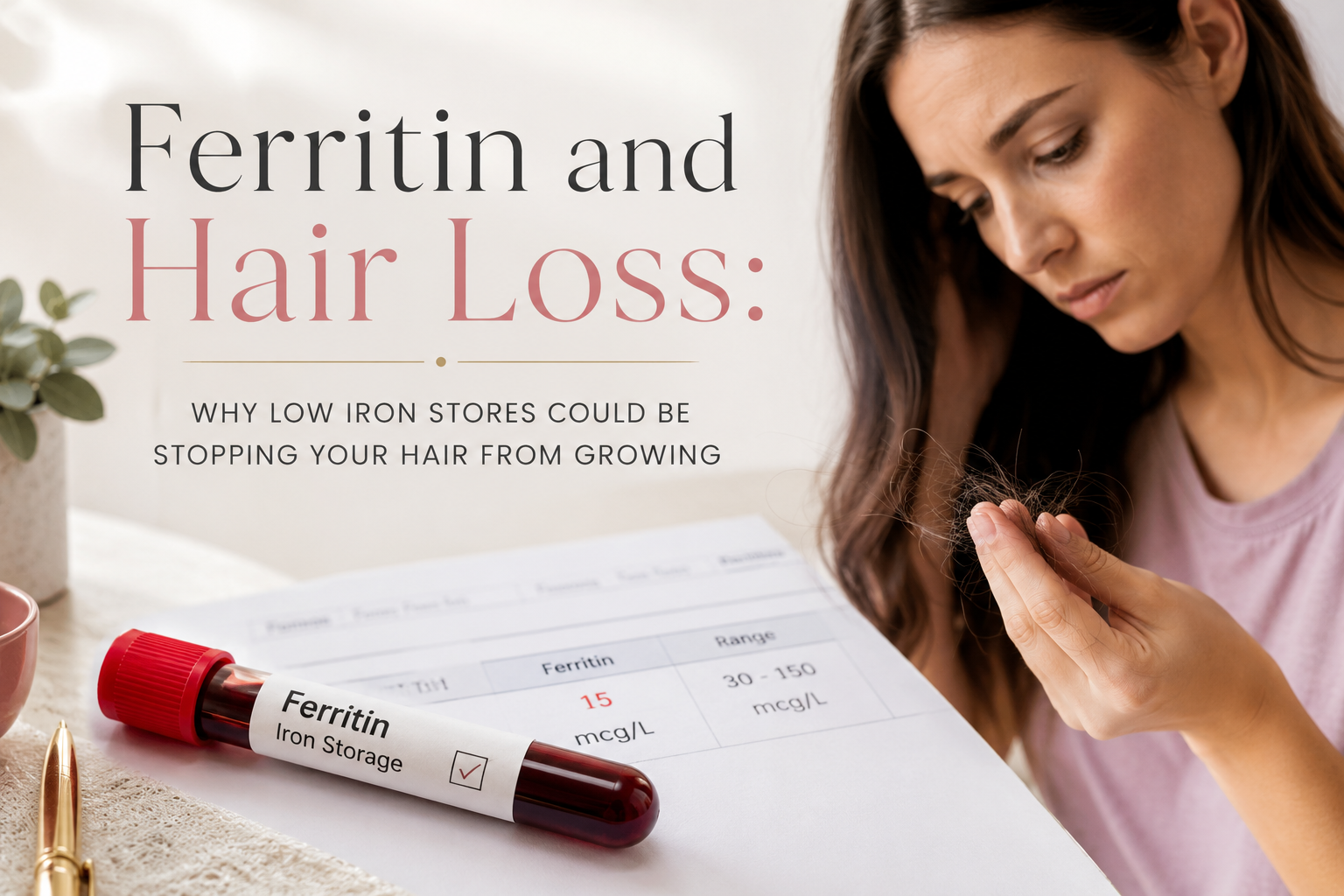
When women think about iron deficiency, they usually think about feeling tired, run down or lightheaded.
What many don't realise is that one of the earliest signs of depleted iron stores can be increased hair shedding.
I've seen countless women who have been told their iron levels are "normal," yet they're losing handfuls of hair every time they wash or brush it. Others have been taking iron supplements for months without seeing any change in their ferritin levels—or their hair.
So why does this happen?
The answer lies in understanding what ferritin actually is.
What is ferritin?
Ferritin is your body's iron storage protein.
Think of it as your iron savings account. Your body stores iron inside ferritin so it has a reserve available whenever it's needed.
Hair follicles are among the most metabolically active tissues in the body. Growing healthy hair requires a constant supply of oxygen and nutrients, and iron plays an essential role in delivering oxygen to rapidly dividing cells.
When ferritin stores become depleted, your body starts prioritising essential organs such as your heart and brain. Hair isn't considered essential for survival, so your follicles may receive fewer resources.
The result?
More hairs enter the resting phase of the hair cycle, leading to increased shedding several months later.
Does low ferritin always cause hair loss?
Not necessarily.
Hair loss is complex, and ferritin is only one piece of the puzzle.
Some people with low ferritin never notice excessive shedding, while others experience significant hair loss even when their ferritin is only mildly reduced.
Research suggests that low iron stores may contribute to certain types of hair loss, particularly diffuse shedding (telogen effluvium), although the exact relationship is still being studied.
This is why ferritin should never be looked at in isolation. Your symptoms, medical history and other blood test results all matter.
Why isn't my ferritin improving?
This is one of the questions I hear most often.
Many women are faithfully taking iron supplements, yet their ferritin barely changes.
If that's you, simply taking more iron isn't always the answer.
Your body first has to digest the iron, absorb it through the intestine, transport it around the body and finally store it as ferritin.
If any step in that process is disrupted, your ferritin may remain low despite supplementation.
Some of the most common reasons include:
1. Poor stomach acid production
Iron requires adequate stomach acid to be released from food and many supplements.
If stomach acid is low, absorption becomes less efficient, meaning less iron reaches your bloodstream.
2. Poor gut absorption
Even if iron is broken down properly, it still has to cross the intestinal lining.
Conditions affecting gut health—including coeliac disease, inflammatory bowel disease and other causes of intestinal inflammation—can reduce how much iron your body absorbs.
3. Hidden digestive conditions
Conditions such as Helicobacter pylori (H. pylori) and Small Intestinal Bacterial Overgrowth (SIBO) may interfere with iron absorption, sometimes without causing obvious digestive symptoms.
4. You're taking a form of iron that doesn't suit you
Different iron supplements are absorbed differently.
Some forms are better tolerated and more readily absorbed than others.
If your ferritin hasn't changed after months of consistent supplementation, it may be worth discussing whether a different form would be more appropriate.
5. Chronic inflammation
Your liver produces a hormone called hepcidin, which regulates how much iron is absorbed and released from storage.
When inflammation is present, hepcidin levels rise, making it harder for your body to absorb and utilise iron effectively.
6. Your hair loss may have more than one cause
Low ferritin is only one possible contributor to hair loss.
Thyroid dysfunction, hormonal changes, vitamin D deficiency, vitamin B12 deficiency, zinc deficiency, inadequate protein intake, significant stress, certain medications and scalp conditions can all affect healthy hair growth.
Often, more than one factor is involved.
Should everyone with hair loss take iron?
No.
Iron supplements should only be taken when they're appropriate for your individual situation and after proper assessment.
Too little iron can contribute to health problems, but too much iron can also be harmful.
That's why it's important to understand your complete iron picture rather than relying on ferritin alone.
A comprehensive iron study usually includes ferritin, serum iron, transferrin saturation and total iron-binding capacity (TIBC). Your healthcare practitioner can help determine what those results mean for you.
The bigger picture
Ferritin is an important piece of the hair-loss puzzle, but it isn't the entire picture.
If your ferritin is low, understanding why it's low is often just as important as replacing the iron itself.
Likewise, if your ferritin is healthy and you're still losing hair, it's worth looking deeper rather than assuming iron is the answer.
Healthy hair starts with understanding what your body is trying to tell you.
When you identify the underlying cause instead of simply treating the symptom, you're far more likely to create lasting improvements—not only for your hair, but for your overall health as well.